For years, I was caught in a cycle of 14+ hour workdays. And weekends, they were just “no meeting” workdays. Always on, always in stress mode. Then came Copilot. Not just a tool, but a turning point for me.
Before I talk about the positive impact it’s had on my life, let’s address the elephant in the room.
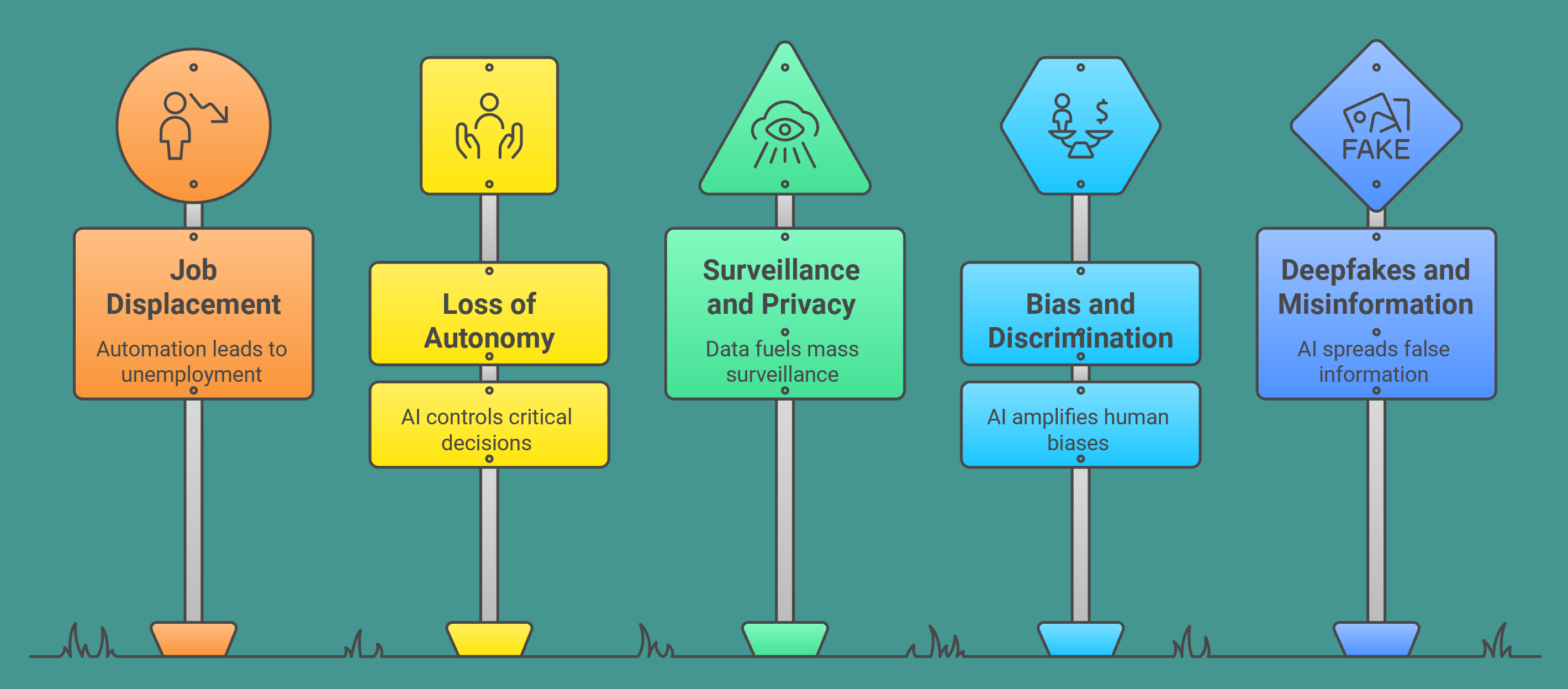
The negative impact / fears surrounding AI:
Job Displacement – One of the most widespread fears is that AI will automate roles across industries, leading to mass unemployment. This concern is especially acute in sectors like customer service, logistics, and even creative fields like writing and design
Loss of Human Autonomy – AI systems making decisions—especially in healthcare, finance, or law -raise ethical concerns about humans losing control over critical judgments.
Surveillance and Privacy Invasion – AI’s ability to process vast amounts of personal data fuels fears of mass surveillance.
Bias and Discrimination – AI systems can inherit and amplify human biases present in training data. This can lead to unfair treatment in hiring, lending, law enforcement, and more.
Deepfakes and Misinformation – The rise of AI-generated content has made it easier to spread false information, manipulate public opinion, and erode trust in media. This is especially dangerous in political contexts and during crises. If I had to pick my biggest “negative” it’s this one.
Environmental Impact – Training and running large AI models consumes massive energy and water resources.
Digital Illiteracy and Exclusion – The real challenge isn’t just deploying AI tools—it’s ensuring people feel confident and capable using them. Without this, many risk being left behind in the digital transformation
Ethical and Moral Concerns – From AI in warfare to decisions about life and death in autonomous vehicles, people worry about the moral frameworks guiding AI.
Reframing Change: From Steam to Silicon – Think back to the Industrial Revolution – both the first and second waves reshaped the world. At the time, many feared they’d lose their jobs and starve. And yes, some did. But those who adapted and evolved with the times found prosperity and new opportunities.
I feel the same way about AI.
Of course, things will change. Job displacement is inevitable. But AI also unlocks possibilities we couldn’t have imagined before – new roles, new industries, and new ways of working.
Maybe it’s time we shift our perspective. Because when we change the way we look at things, the things we look at begin to change.
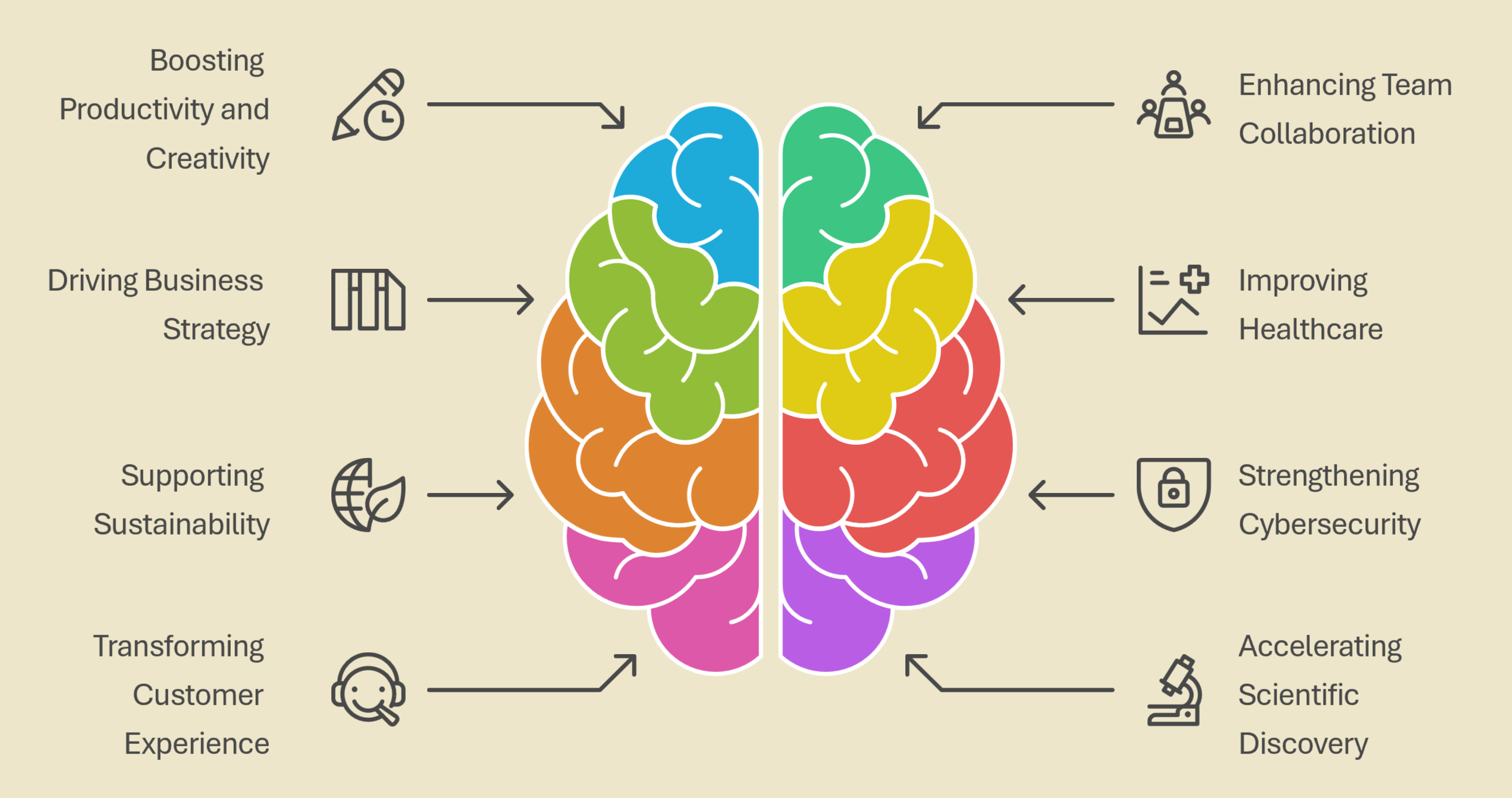
Here are some of the positive impacts of AI:
Boosting Productivity and Creativity – AI tools like Microsoft Copilot are freeing up time for employees to focus on higher-value tasks.
Enhancing Team Collaboration – Copilot, acts as a “team member” that facilitates meetings, tracks tasks, and manages team time. It integrates with tools like Teams, Loop, and Planner to streamline collaboration and improve project outcomes.
Driving Business Strategy – AI can be aligned with business goals to create transformational strategies. It’s not just about tech – it’s about impact.
Improving Healthcare – AI is revolutionizing diagnostics, treatment planning, and patient care.
Supporting Sustainability – AI is helping tackle climate change by optimizing energy use, improving agricultural practices, and supporting environmental monitoring
Strengthening Cybersecurity – AI systems can detect threats faster than traditional methods, helping organizations stay ahead of cyberattacks
Transforming Customer Experience – AI enables hyper-personalized marketing and customer service.
Accelerating Scientific Discovery – AI is being used to analyze massive datasets in fields like genomics, physics, and climate science, uncovering insights that would take humans years to find.
Me and Copilot: A Journey from Burnout to Balance
Alright, enough about AI – let’s talk about me and Copilot.
I’ve always been an overachiever. Meeting expectations wasn’t enough – I had to exceed them. But that drive came at a cost. My health paid the price for my passion. Some of you may know that I had a stroke on 31 August 2021. Back then, I was working 14 to 18-hour days, weekends and holidays included, fueled by coffee and adrenaline. Meals were skipped, exercise was forgotten, and water was a luxury I rarely remembered.
Over the past four years, I’ve worked hard to change that. I even considered changing my profession, but knowing that my work ethic was embedded in my DNA – I knew this was not an option. Saying “no” was foreign to me. Boundaries? What boundaries? It served me well as a consultant – but not as a human being. Could I deliver? Absolutely. Could I sustain it? Not a chance.
When PowerPoint Designer launched, I resisted. I wasn’t about to let a “bot” tell me how to design slides – I had a PowerPoint tattoo, after all. But over time, I saw the value. I could do more. And eventually, I could do better.
My days are filled with back-to-back meetings, often 8 hours straight, where I lead, facilitate, and train. I’m always on camera, multitasking never an option. The real work – creating content, building proposals, designing strategies – happens after hours. I rely on frantic OneNote scribbles to track tasks and delegate. Switching between clients every hour means mentally shifting gears in seconds. It’s a hectic lifestyle, and honestly, I’m surprised I only had a stroke at 46 – and even more surprised I walked away from it.
Enter Copilot.
I started trusting it. With a full license, it references my own work – my documents, my notes, my history. That’s gold. I don’t have to remember what I did, when, or for whom. Copilot doesn’t replace my expertise – it curates it. It’s like having a brilliant researcher or secretary by my side. And as a perfectionist, I now reach “end state” faster when creating content.
I’ve also started recording all my meetings, giving me access to insights and notes that used to take hours to compile.
So, have I stopped working 14–16 hour days? No. Weekends? Still working. But now, I see pockets of blue sky. I sit on my “stoep” (patio), my favourite Beyerdynamic Amiron headphones on, music flowing, swinging in my favorite hanging chair, watching garden birds. Sometimes, there’s Prosecco involved. That elusive balance everyone talks about? I’m starting to feel it. Maybe, just maybe, now after 50, I’ll slow down enough to enjoy the fruits of my hard work.
So, thank you, Microsoft, for giving me back some of my life. And yes, even as a South African, I don’t mind paying $30 for the Copilot license. It’s worth every cent.
The ROI of Copilot: More Than Just Productivity
I’ve spent years helping organizations measure the ROI of employee productivity. It’s not easy – but it’s real.
Companies hesitate to invest in training yet burn 20%+ of their salary spend every month on inefficiencies. It blows my mind. How can you not invest in your greatest asset – your people, and empower them to achieve more?
We’re no longer debating whether to get Microsoft 365 licenses (you don’t really have a choice). The real question is:
Should we pay the extra $30 for Copilot?
My answer?
Absolutely.
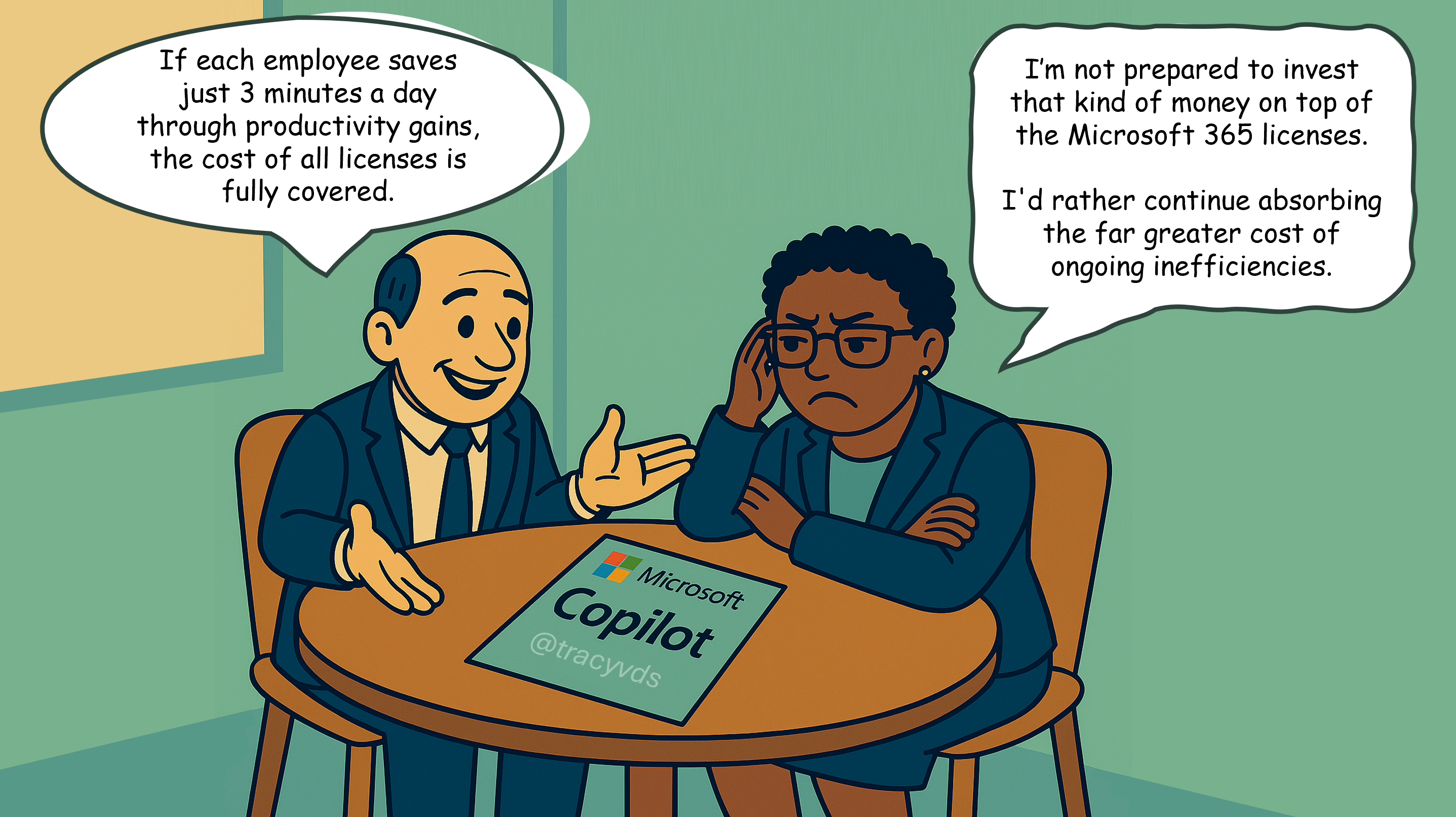
Productivity Savings: A Simple, Eye-Opening Calculation
Measuring productivity gains can be tricky. So instead of trying to quantify what’s been “saved,” I prefer to look at what’s being lost – specifically, time wasted due to inefficiencies. Then I compare that against salary costs. It’s a straightforward calculation, and yes, I know the salary figures I use aren’t perfect. Directors and C-level executives earn significantly more, so the potential savings are even greater.
For context, I’ve used South African salary benchmarks – but in the end, it’s all just monopoly money if we don’t act on it. That R300,000/month CEO salary I referenced? Some earn between R2.5 million and R5 million per month. So let’s not get stuck in the detail – focus on the impact.
Want to see the real cost of inefficiency?
Go ask HR for average salary data and run the numbers yourself. You’ll be shocked at how much money is burned each month – not because employees aren’t working hard, but because they’re working inefficiently. And that’s not their fault.
According to Sci-Tech Today :
The average office worker wastes 2.9 hours per day on non-work activities and inefficient processes.
- 89% of employees admit to wasting at least 30 minutes daily, and 18.5% waste 3+ hours.
- Major culprits? Inefficient meetings and email overload.
Let that sink in: 30 minutes a day – admitted!
My own calculations are conservative, estimating savings of just 5 to 10 minutes per day. So yes, you can easily multiply those savings by 3.
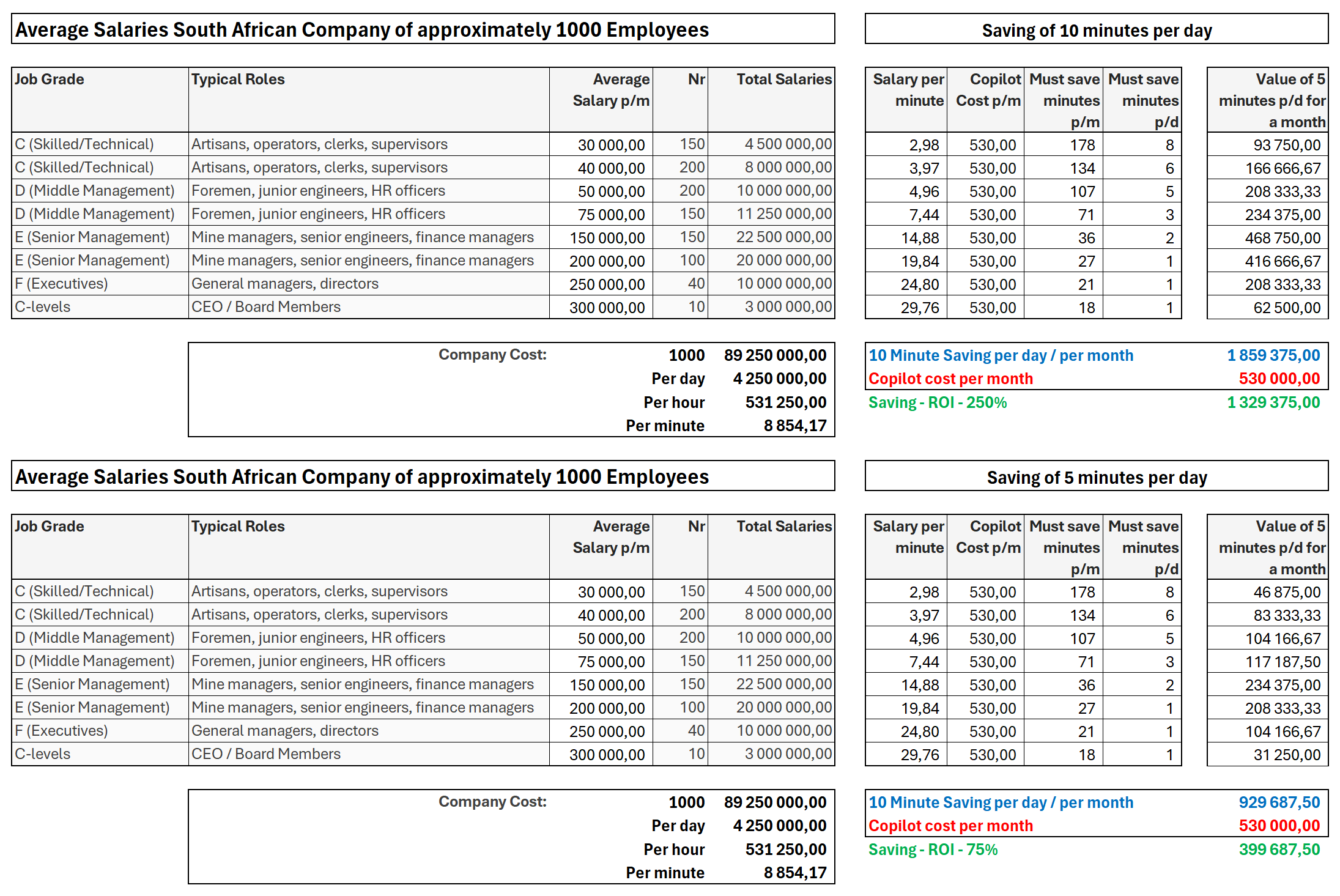
So what are you waiting for?
If you haven’t already, go ahead and get those Copilot licenses. But don’t stop there – make sure your employees are trained too. Search and prompt skills aren’t instinctive – they need to be taught, practiced, and refined.
Empower your teams to get the most out of the tools you’re investing in. The ROI starts with adoption, and adoption starts with capability.
Contact me:
Do you need help with your #Microsoft365 journey? Contact me.
Please DO NOT contact me to publish blogs on your behalf, advertise on my site, endorse your product or solve a problem you have (that could have been solved by posting on an online forum). As part of the #Micosoft365 #Copilot #Community, we work really hard on content and support that we give back to you, for free – because we really do care. You are always welcome to leave (relevant) comments on my blogs / videos, and I’ll respond, as this way, others also get value from it.
Stay awesome, keep learning, help others.

 Tracy van der Schyff
September 10, 2025 at 11:24 am
Brilliant, as ever!
Alex Morel
Senior Consultant & Trainer | ALX Training
ALX TRAINING LTD
T: +44 1534 873785 | E: alex@alxtraining.com
Windward House, La Route de la Liberation, St Helier, Jersey, JE1 1BG
http://www.alxtraining.comhttps://www.alxtraining.com
September 14, 2025 at 7:52 pm
👍👍👍